Design for circularity in fire safety systems
How to turn end-of-life fire extinguishers into certified resources — and why this changes everything for European companies.
The problem nobody wants to address
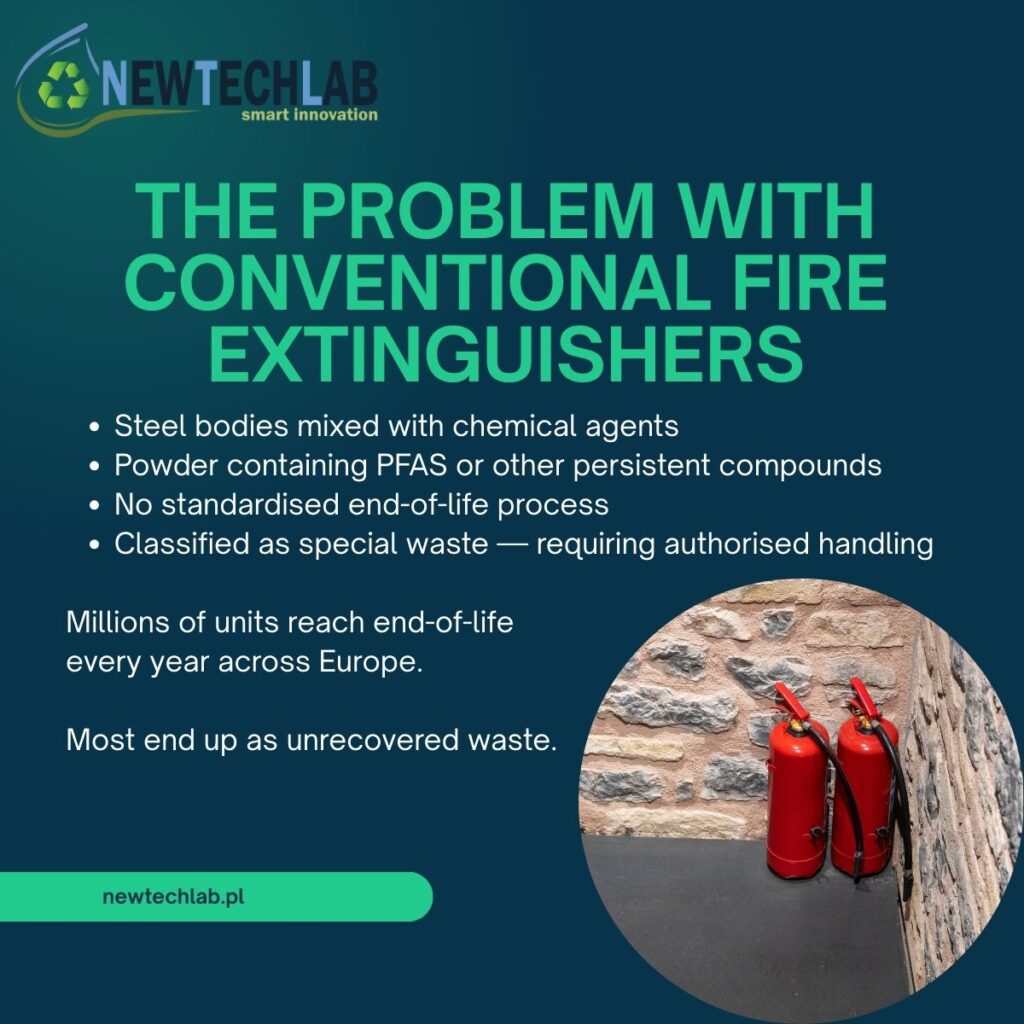
Every year, millions of fire extinguishers reach the end of their useful life across Europe. They are classified as special waste, require authorised transport and certified disposal. Most end up in landfill or are managed through processes that disperse materials without recovering them.
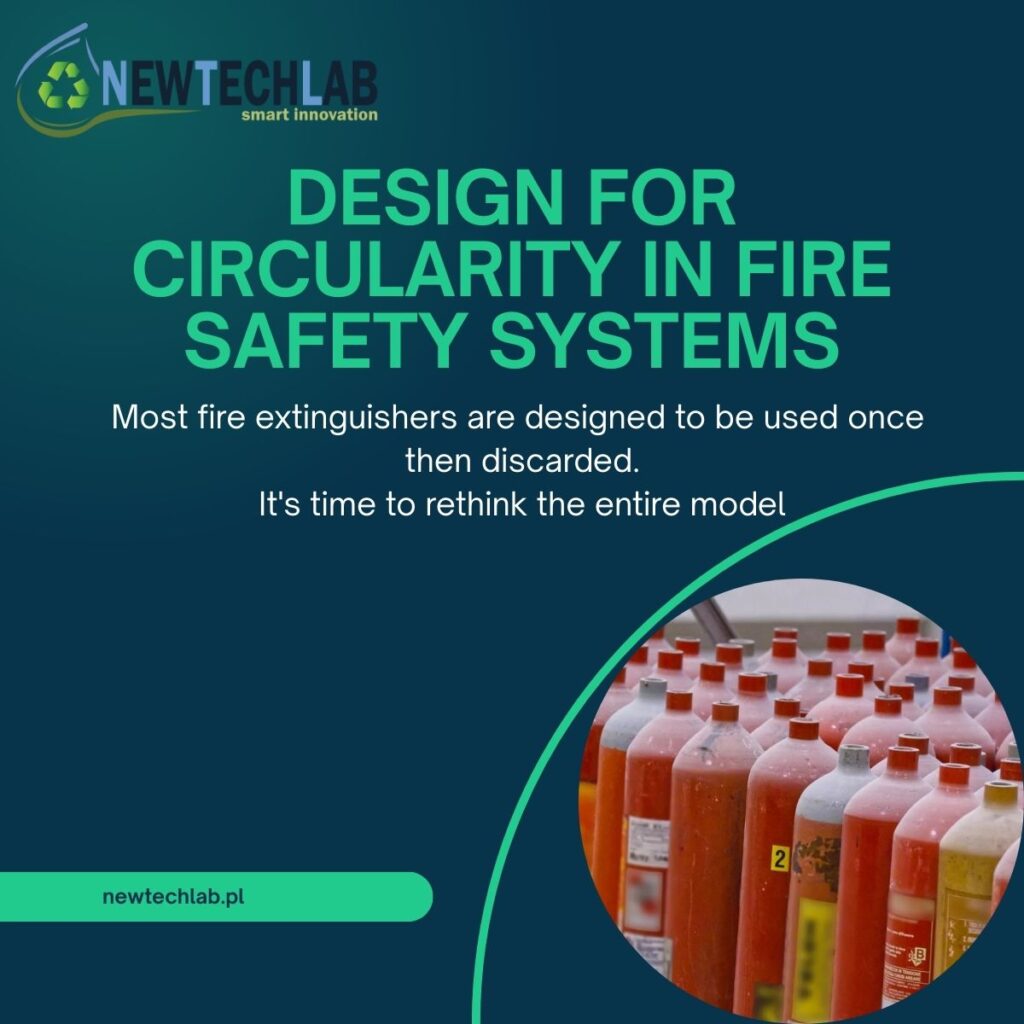
The reason is simple: conventional fire extinguishers were not designed to be recycled. They were designed to work once — and then disappear.
This approach carries a growing environmental, economic and regulatory cost. With the entry into force of Regulation (EU) 2025/1988 on PFAS in extinguishers (deadline 23 October 2026 for portable extinguishers) and the evolution of CSRD (Omnibus I, December 2025), companies managing fire safety equipment face a concrete choice: continue treating extinguishers as a disposal problem, or start treating them as a resource.
What “design for circularity” actually means
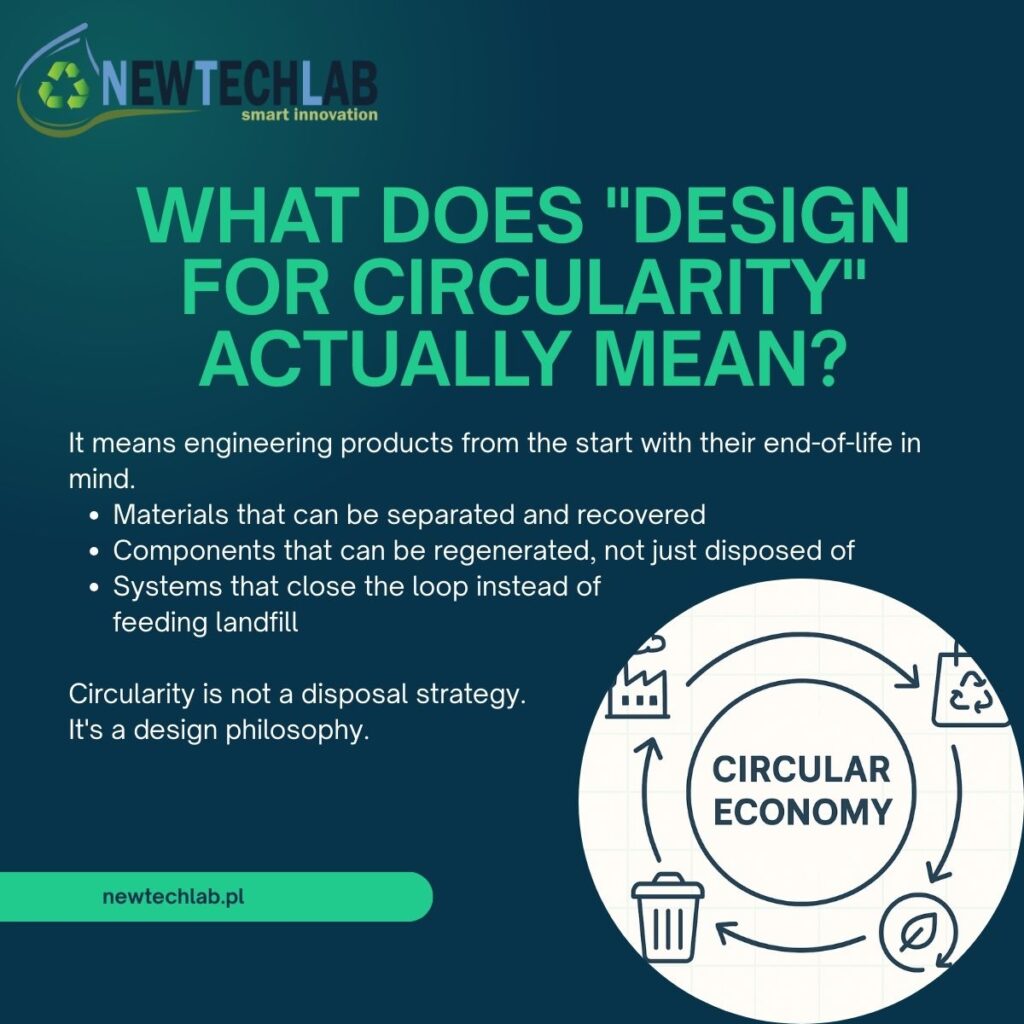
Design for circularity means engineering products and processes from the outset with their end-of-life phase in mind.
In the context of fire safety, this translates into:
- Separable and recoverable materials: steel bodies, valves, and mechanical components that can be disassembled and reintroduced as secondary raw materials.
- Regenerable extinguishing agents: ABC powders that, rather than being disposed of, are processed and transformed into a certified product ready for use.
- Traceable and compliant logistics: every phase of the cycle — collection, transport, processing — documented and verifiable in accordance with European regulations.
- Zero landfill: a total component recovery objective, with no unrecovered residues.
Circularity is not a disposal strategy. It is a design philosophy that starts upstream, not downstream.
The circular cycle applied to fire extinguishers: how it works
A fire safety system designed for circularity follows a precise path:
1. Certified collection and transport Expired or damaged extinguishers are collected from clients by operators registered in the BDO system, with correct waste codes and waste transfer documentation (KPO — Karta Przekazania Odpadów — in Poland; equivalent national documentation applies in other EU countries). The transport of used extinguishers falls under the special waste category: it cannot be entrusted to generic carriers without specific authorisation.
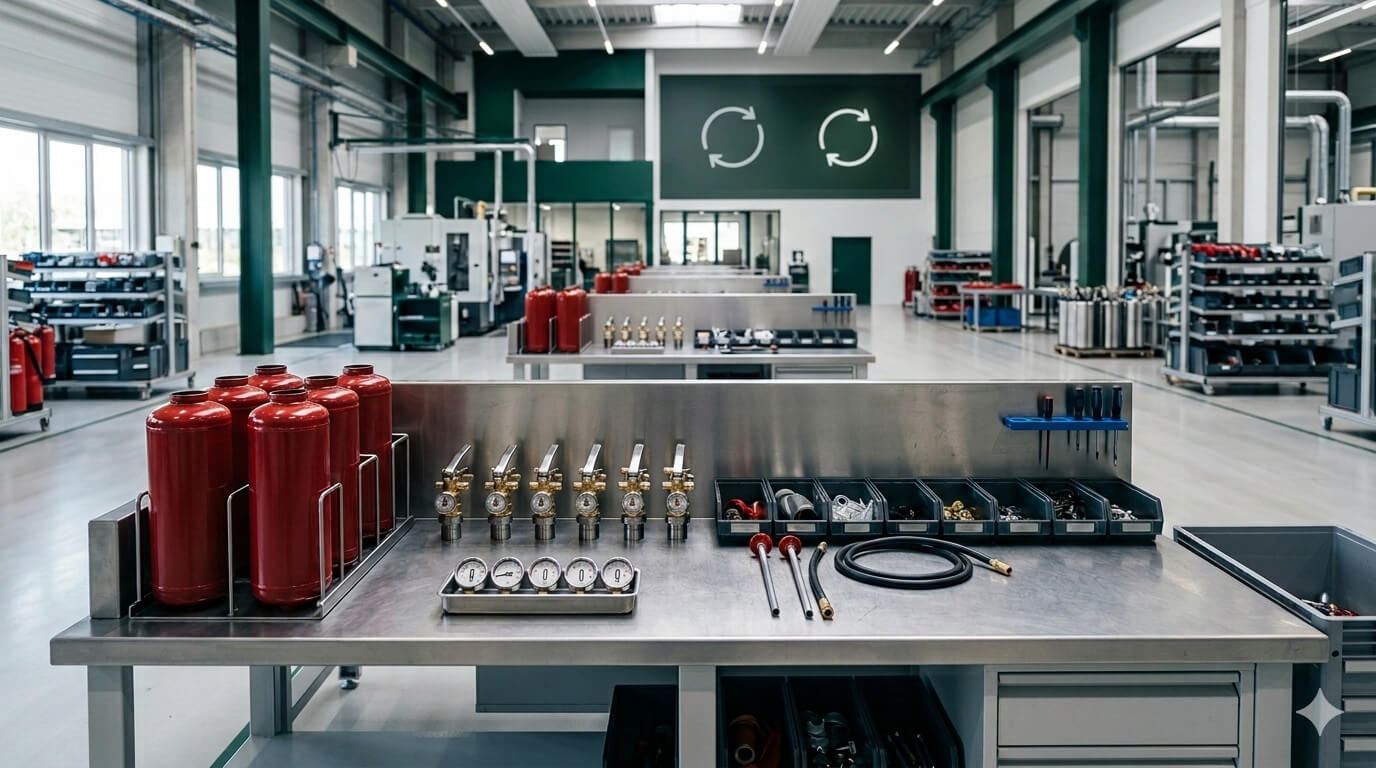
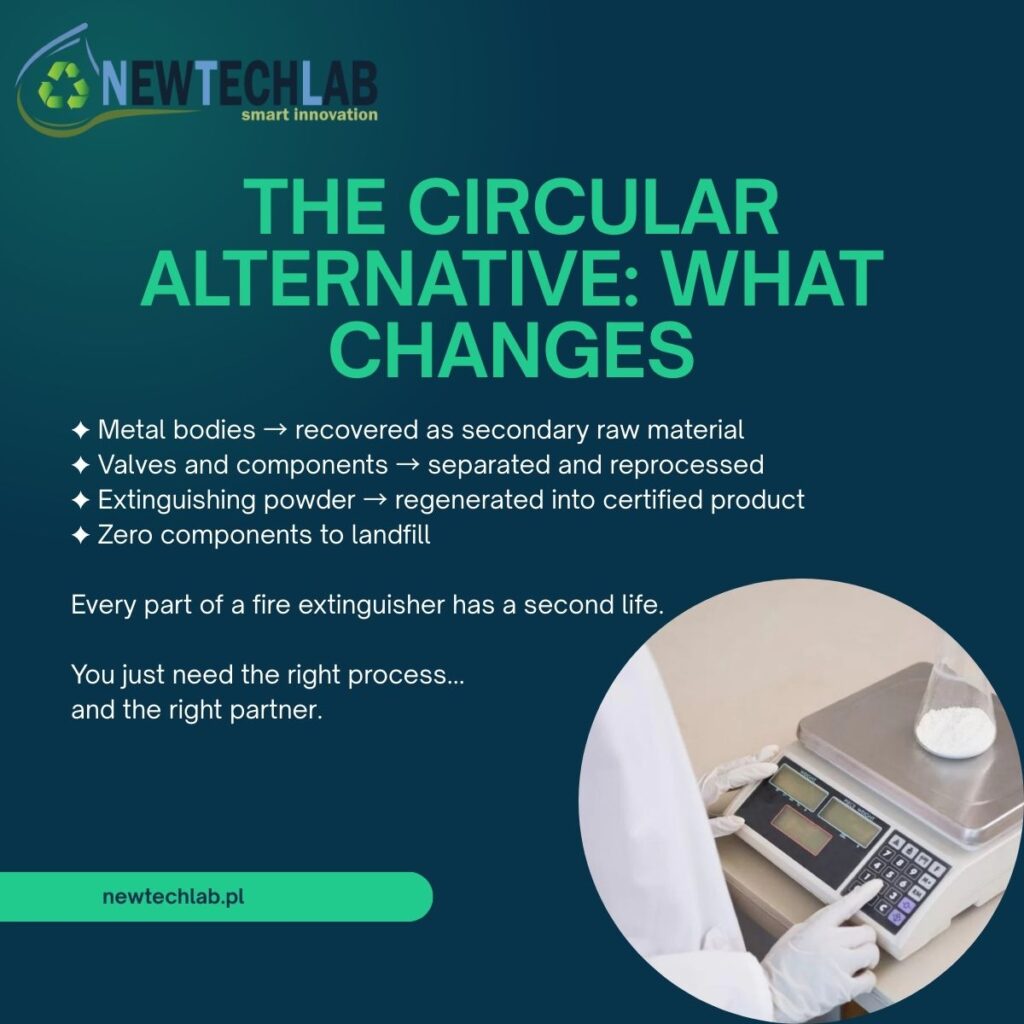
2. Disassembly and separation Each extinguisher is dismantled component by component: steel body, valve, pressure gauge, extinguishing powder. Each material enters a dedicated recovery or regeneration stream. The goal is 100% component recovery.
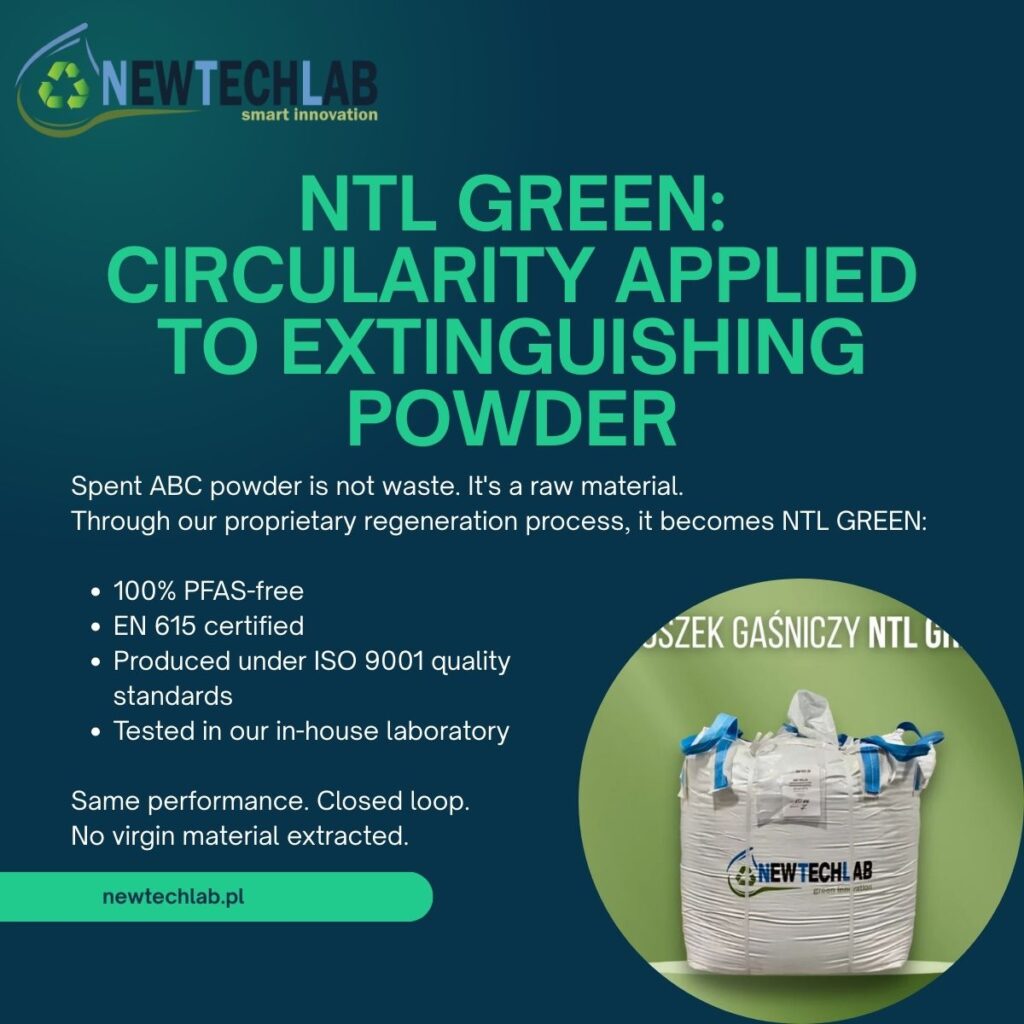
3. Extinguishing powder regeneration This is the most critical and technologically advanced phase. Spent ABC/BC powder is subjected to a proprietary regeneration process that transforms it into a certified product, tested in an in-house laboratory and compliant with EN 615. The result is NTL GREEN: regenerated extinguishing powder, 100% PFAS-free, produced under ISO 9001 quality standards.
4. Metal and component recovery Steel, brass and other metals are reintroduced into the production cycle as secondary raw materials, reducing the need for virgin resource extraction.
5. Zero landfill The entire process operates under a Zero Waste policy: every component finds a recovery or reuse destination.
The PFAS issue: why it is central to fire safety circularity
PFAS (per- and polyfluoroalkyl substances) are extremely persistent synthetic chemical compounds. They are called “forever chemicals” because they do not degrade in the environment and tend to accumulate in soil, water and living organisms.
Many traditional extinguishing agents — foams and powders — contain PFAS as functional components. This means that every use, every test and every non-compliant disposal causes these substances to be released into the environment.
The European Union adopted Regulation (EU) 2025/1988 (2 October 2025), introducing Entry 82 into Annex XVII of REACH: from 23 October 2026, firefighting foams in portable fire extinguishers cannot be placed on the market with PFAS concentrations equal to or above 1 mg/L. The prohibition extends to all firefighting foams by 23 October 2030.
For companies managing fire safety equipment, this translates into:
- Regulatory non-compliance risk for products that do not meet the new thresholds
- Supply chain liability for those purchasing or distributing extinguishing agents containing PFAS
- ESG reporting impact for companies subject to CSRD
Using PFAS-free certified products is not just an environmental choice. It is a concrete response to a rapidly evolving regulatory risk.
Why circularity in fire safety is still rare
Achieving a truly circular process for fire extinguishers and extinguishing powders requires a combination of capabilities that few organisations can meet simultaneously:
- Special waste transport authorisation (BDO registration, correct waste codes, KPO documentation)
- Certified processing infrastructure with disassembly, separation and regeneration capability
- In-house analytical laboratory to test particle size distribution, hygroscopicity, extinguishing efficiency and MAP content
- ISO 9001, ISO 14001, ISO 50001 certifications ensuring quality, environmental management and energy efficiency
- Years of R&D to validate regenerated products against European regulatory standards
The absence of even one of these elements breaks the circular chain. And that is precisely why most companies stop at disposal.
The competitive advantage for client companies
For companies managing fleets of fire extinguishers — manufacturing, logistics, large-scale retail, public bodies — working with a partner that offers a certified circular process delivers measurable benefits:
On regulatory compliance Traceable documentation for every extinguisher collected, with correct waste codes and BDO registration. Zero exposure to administrative or criminal penalties for unauthorised transport.
On ESG and reporting Certified data on recovery, recycling and regeneration rates, CO₂ metrics and resource utilisation. Indicators ready to be integrated into CSRD sustainability reports.
On environmental performance Reduction in virgin raw material extraction, lower CO₂ emissions linked to the production of new powders, elimination of landfill disposal.
On reputation Use of certified PFAS-free products, with a positive impact on the company’s sustainability positioning towards clients, investors and stakeholders.
NEW TECH LAB: circularity as an industrial process
NEW TECH LAB is a company based in Skawina, Poland, specialising in the collection, certified transport, disassembly and regeneration of fire extinguishers and extinguishing powders.
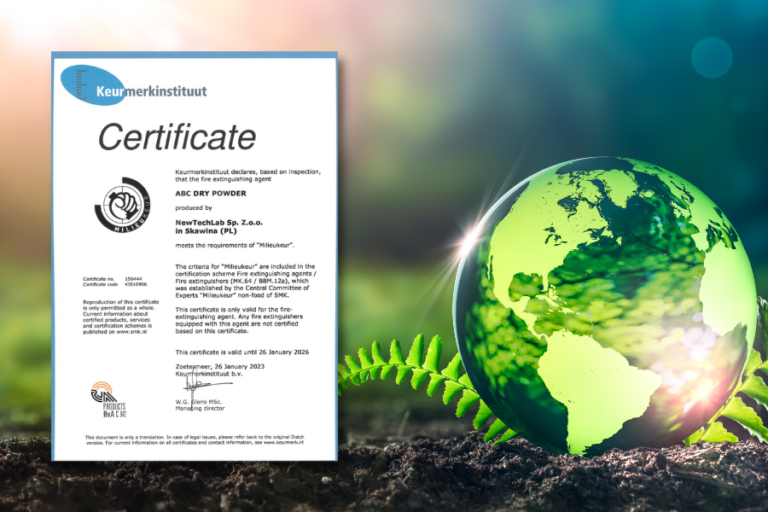
Their main product, NTL GREEN, is a regenerated extinguishing powder: – 100% PFAS-free – Compliant with EN 615 – Produced under ISO 9001 – Tested in-house and certified by third-party bodies (Keurmerk Institute, NL)
The company operates under an Integrated Management System certified to ISO 9001:2015, ISO 14001:2015 and ISO 50001:2018, is registered in the BDO system under number 000141354, and is authorised for the transport, collection, recycling and disposal of waste from fire safety equipment across Europe.
FAQ — Frequently asked questions
Circularity in fire extinguishers means managing the entire device lifecycle: from certified collection at end of useful life, through component disassembly and separation, to the regeneration of extinguishing powder as a new certified product. The objective is to recover 100% of materials with zero landfill.
Yes. Expired or damaged fire extinguishers are classified as special waste under European regulations. Their transport requires an operator registered in the BDO system with correct waste codes and transfer documentation. Entrusting transport to an unauthorised carrier exposes the waste producer to joint administrative and criminal liability.
It is a spent ABC/BC powder that, through a certified processing and regeneration procedure, is transformed into a product compliant with regulatory standards and ready for use. NEW TECH LAB’s NTL GREEN regenerated powder is 100% PFAS-free and EN 615 certified.
PFAS (per- and polyfluoroalkyl substances) are persistent chemical compounds found in many traditional extinguishing agents. They do not degrade in the environment and accumulate in living organisms. The EU is progressively restricting their use. Companies using products containing PFAS are exposed to growing regulatory risk and negative impacts on their ESG reporting.
It means the product contains no per- and polyfluoroalkyl substances at any stage of its composition or production. PFAS-free certification, combined with EN 615 compliance, guarantees that the powder is effective, environmentally safe and compliant with current and future European regulations.
A certified circular partner provides traceable and verifiable data on recovery, recycling and regeneration rates, avoided CO₂ metrics and resource utilisation. These indicators integrate directly into the environmental component (E) of ESG reports aligned with CSRD and the EU Taxonomy.
The essential certifications are: ISO 9001 (quality), ISO 14001 (environmental management), ISO 50001 (energy efficiency), BDO registration with authorisation for special waste transport and processing. The presence of an in-house analytical laboratory is an additional indicator of process reliability.
Yes. Any company or organisation managing fire extinguishers — manufacturing, logistics, retail, public administration, facility management — can adopt a certified circular management model. It requires no internal investment: it is simply a matter of choosing the right partner for collection and processing.
Sources
- Regulation (EU) 2025/1988 — PFAS in firefighting foams Official text, EU Official Journal 🔗 https://eur-lex.europa.eu/eli/reg/2025/1988/oj/eng
- Technical analysis Reg. (EU) 2025/1988 — TÜV Rheinland 🔗 https://www.tuv.com/regulations-and-standards/en/europe-regulation-eu-2025-1988-annex-xvii-entry-82-per-and-polyfluoroalkyl-substances-in-firefighting-foams.html
- CSRD Omnibus I — Council of the European Union Provisional agreement December 2025 🔗 https://www.consilium.europa.eu/en/press/press-releases/2025/12/09/council-and-parliament-strike-a-deal-to-simplify-sustainability-reporting-and-due-diligence-requirements-and-boost-eu-competitiveness/
- Stop-the-Clock Directive (EU) 2025/7942 — Sidley Austin 🔗 https://www.sidley.com/en/insights/newsupdates/2025/04/eu-omnibus-package-eu-adopts-stop-the-clock-directive-and-begins-esrs-simplification-process
- CSRD — new thresholds and implications — Morrison Foerster 🔗 https://www.mofo.com/resources/insights/251222-eu-sustainability-omnibus-i-detailed-omnibus
- BDO system (Polish waste register) 🔗 https://bdo.mos.gov.pl
- ISO standards (9001 / 14001 / 50001) 🔗 https://www.iso.org