ABC extinguisher life cycle: from collection to recycling
Key points
- An expired ABC extinguisher holds a metal body, valves and powder based on monoammonium phosphate.
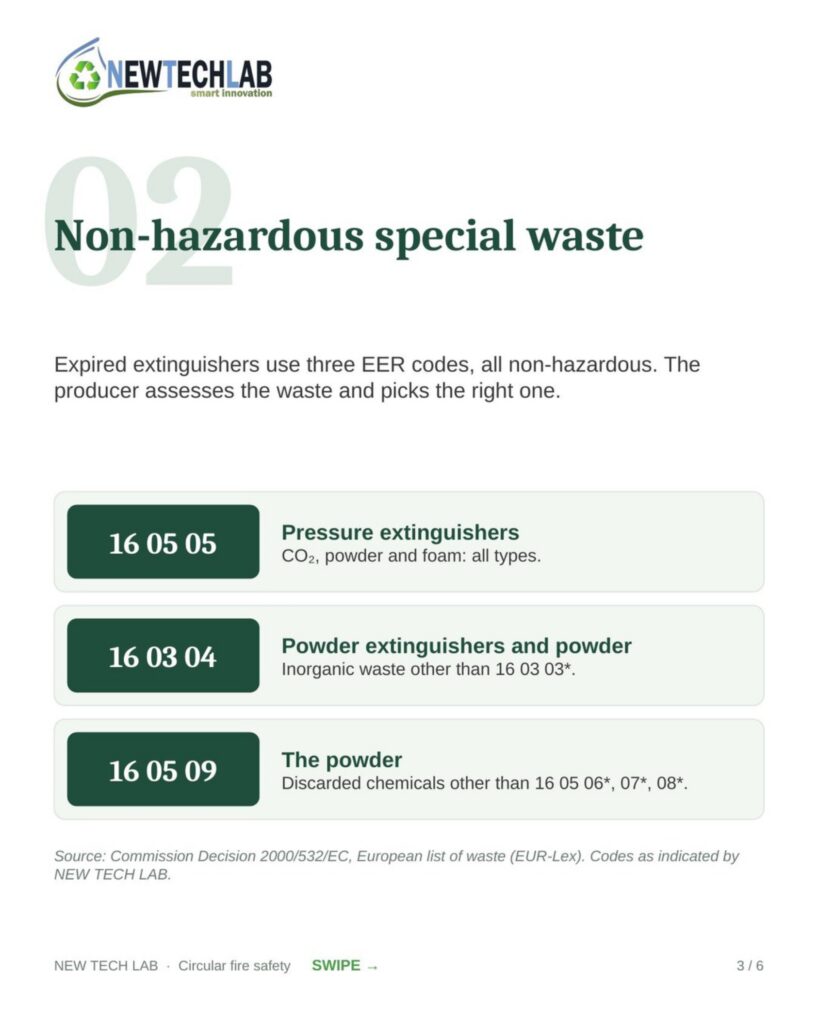
- Expired extinguishers use non-hazardous EER codes: 16 05 05 for all pressure types, 16 03 04 and 16 05 09 for powder.
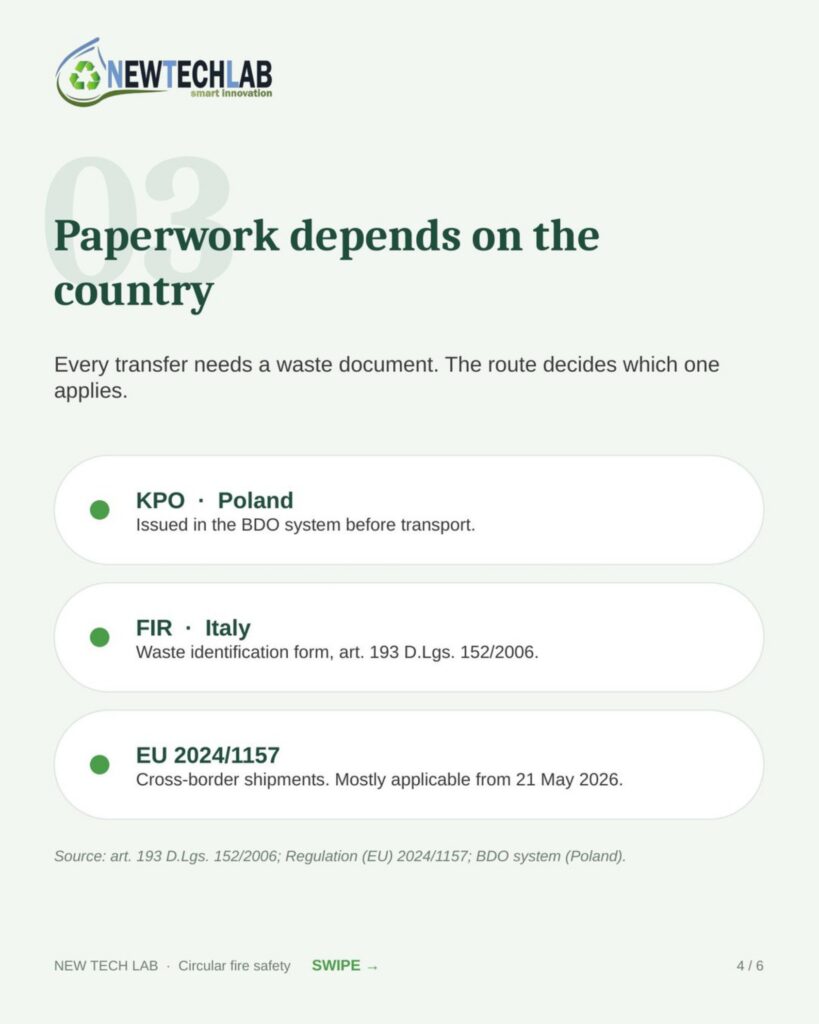
- Poland requires the KPO, Italy the FIR. Shipments between Member States follow Regulation (EU) 2024/1157.
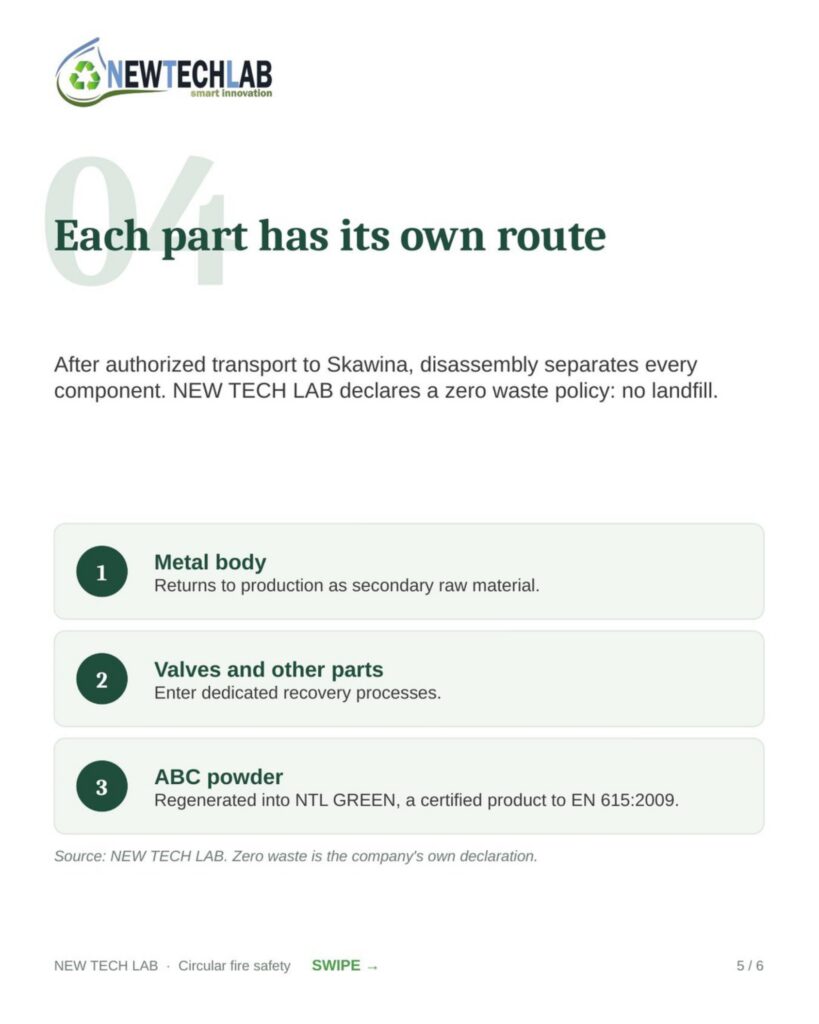
- Disassembly separates every component and sends it to a dedicated recovery route.
- NTL GREEN is the regenerated powder: a certified product conforming to EN 615:2009.
What an expired ABC extinguisher contains
An expired ABC extinguisher is not a single object. It is a set of components, and each one follows a different recovery route. The parts to separate are the metal body, the ABC powder, the valves and other components. The metal body is also a vessel that has held pressure. For this reason it is not handled as ordinary waste.
ABC powder is the extinguishing agent for class A, B and C fires. Its main component is monoammonium phosphate. A safety data sheet from Amerex, hosted by the US Forest Service (USDA), puts it at 90-97% of the weight. The rest consists of mineral additives, such as fuller’s earth and mica. However, the formulation varies from product to product.
The EN 615:2009 standard sets minimum requirements for these powders. You can consult it at BSI Knowledge and en-standard.eu. For details on the tests, read the article EN 615 and extinguishing powders.

Why it is non-hazardous special waste
In Italy, Legislative Decree 152/2006 classifies waste by origin and hazard. A training module from the Florence Chamber of Commerce explains this (in Italian). Extinguishers discarded by businesses and institutions come from economic activities. As a rule, therefore, they are special waste. The producer then assesses whether the waste has hazardous properties. Finally, it classifies the waste as hazardous or non-hazardous.
At European level every waste receives a six-digit code from the list in Decision 2000/532/EC. An asterisk marks hazardous waste, as in code 16 05 04*. Moreover, for expired extinguishers NEW TECH LAB indicates three codes, all non-hazardous:
- 16 05 05: gases in pressure containers other than those mentioned in 16 05 04*. It therefore applies to all pressure extinguishers: CO₂, powder and foam.
- 16 03 04: inorganic wastes other than those mentioned in 16 03 03*. It is used instead for powder extinguishers and for the powder.
- 16 05 09: discarded chemicals other than those mentioned in 16 05 06*, 16 05 07* and 16 05 08*. It is therefore used for the powder.
The producer still assesses the hazard properties. Then it chooses the code that fits its own waste.
The transport document depends on the country. In Italy, transport is accompanied by the waste identification form (FIR), required by article 193 of Legislative Decree 152/2006. In Poland the KPO (Karta Przekazania Odpadów) is used instead, issued in the BDO system. Its steps are explained in the BDO and KPO guide.
Disassembly and separation: each part has its route
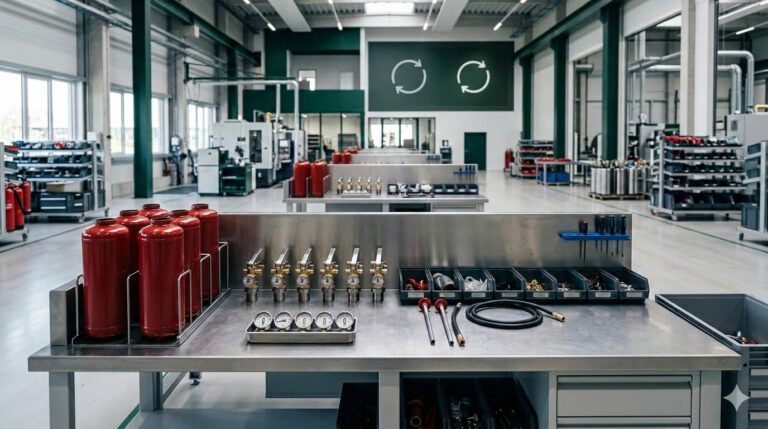
After authorised transport to Skawina, disassembly begins. According to NEW TECH LAB, the operation is careful and separates the metal body, the ABC powder, the valves and other parts. Each component then enters a dedicated recovery or regeneration process. The declared goal is total recovery of the components.
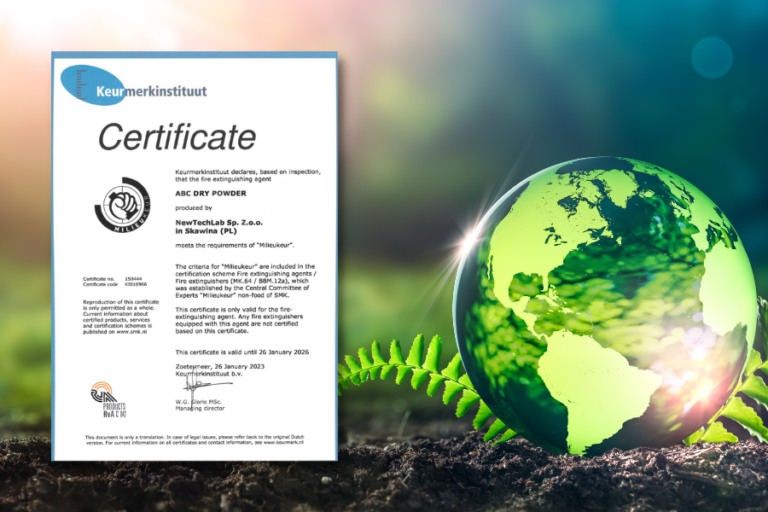
The ABC powder is regenerated and analysed before certification. The full process is described in the article on how NEW TECH LAB regenerates extinguishing powders (in Italian). The in-house analyses are presented on the laboratory services page. The result is NTL GREEN, a certified product conforming to EN 615:2009 and certified by Keurmerk Institute.
Recovered metals and other components return to production as secondary raw materials. Moreover, NEW TECH LAB declares a zero waste policy, with no landfill.
What changes for those handling expired extinguishers
First, classification remains an assessment by the waste producer. It is therefore worth checking before collection, with an environmental consultant in case of doubt. Then the documents change with the destination country, as seen above.
In addition, shipments between Member States follow Regulation (EU) 2024/1157, largely applicable from 21 May 2026. The European Parliament summary explains it. The text updates shipment procedures with a circular focus and strengthens controls. Finally, the producer keeps the KPO or FIR as proof of handover.
Frequently asked questions
All are non-hazardous. Code 16 05 05 covers pressure extinguishers of every type: CO₂, powder and foam. Codes 16 03 04 and 16 05 09 concern powder. The producer still assesses the hazard properties of its own waste.
In Italy transport is accompanied by the FIR. In Poland the KPO is used, issued in the BDO system before transport. Which procedure applies depends on the country where the transport takes place.
The regulation governs waste shipments and is largely applicable from 21 May 2026. It therefore affects transfers between Member States, such as shipments to a facility in Poland.
How to start certified collection of ABC extinguishers
- Survey the extinguishers
Count the expired units and note type and location. Estimate the quantity of waste. This data is needed for classification and for the quote.
- Classify the waste
Check the EER code. Use 16 05 05 for pressure extinguishers, 16 03 04 or 16 05 09 for powder. If in doubt, ask an environmental consultant.
- Choose an authorised operator
Check registration in the BDO register, which is public. NEW TECH LAB is registered under number 000141354. Also verify transport authorisations.
- Prepare the documents
In Italy, complete the FIR. In Poland the KPO is issued in BDO, as the guide explains. Shipments between Member States follow Regulation (EU) 2024/1157.
- Keep the evidence
Archive the KPO or FIR and the documents proving handover and final recovery.
Sources
- EUR-Lex – Decision 2000/532/EC, European list of waste
- European Commission – Regulation (EU) 2024/1157 on waste shipments
- European Parliament – summary of the waste shipment procedure
- BDO – public register (Poland)
- Florence Chamber of Commerce – waste classification and traceability (Italian)
- Florence Chamber of Commerce – article 193 Legislative Decree 152/2006, FIR (Italian)
- ABC Dry Chemical safety data sheet (Amerex) – USDA Forest Service
- BSI Knowledge – BS EN 615:2009
- en-standard.eu – BS EN 615:2009