EN 615: the European standard for ABC extinguishing powder
EN 615:2009 is the European standard of reference for extinguishing powders intended for fire classes A, B and C; it does not apply to class D powders, for which several European countries maintain specific national regulations. Drawn up by CEN (European Committee for Standardization), the standard sets the minimum chemical-physical requirements and the minimum extinguishing performance a powder must guarantee to be considered marketable within the European market, through defined test methods (BSI Knowledge).
What is the EN 615 standard
Beyond the technical requirements, the standard also specifies the information and data the manufacturer must provide to the customer with each supply (en-standard.eu).
For a company that produces, distributes or regenerates ABC extinguishing powders, EN 615 is not optional: it defines the minimum quality and safety standard every batch must meet, whether the powder is virgin or regenerated.
For NEW TECH LAB, EN 615 is the essential regulatory reference for every ABC extinguishing powder placed on the market through its certified product NTL GREEN, obtained through a controlled regeneration process of expired ABC extinguishing powders.
What EN 615 certifies for ABC powder
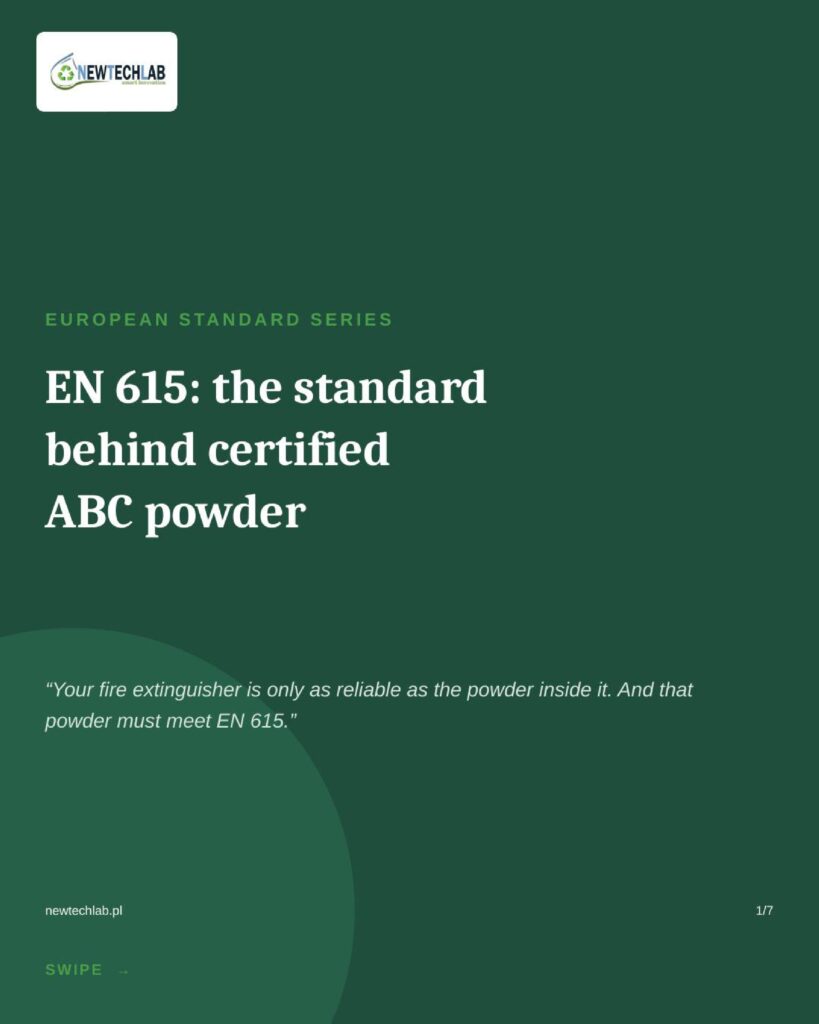
The standard defines, through standardized test methods, the minimum chemical-physical requirements and minimum extinguishing performance an A, B and C class powder must meet (BSI Knowledge).
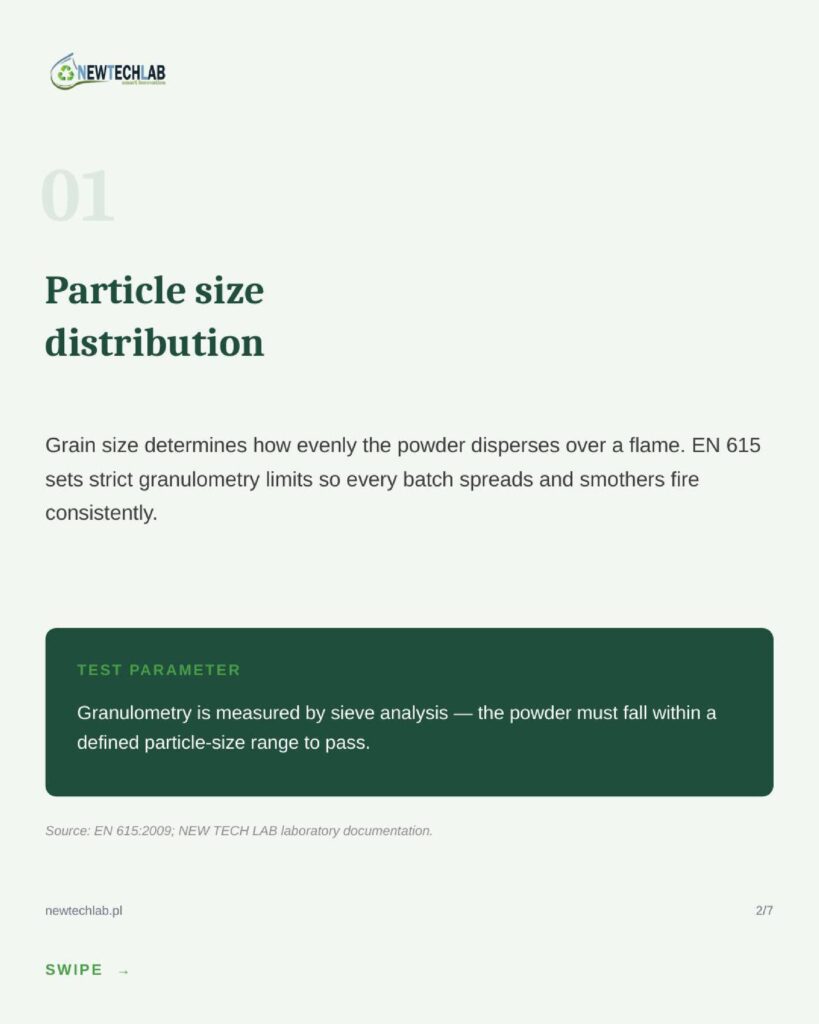
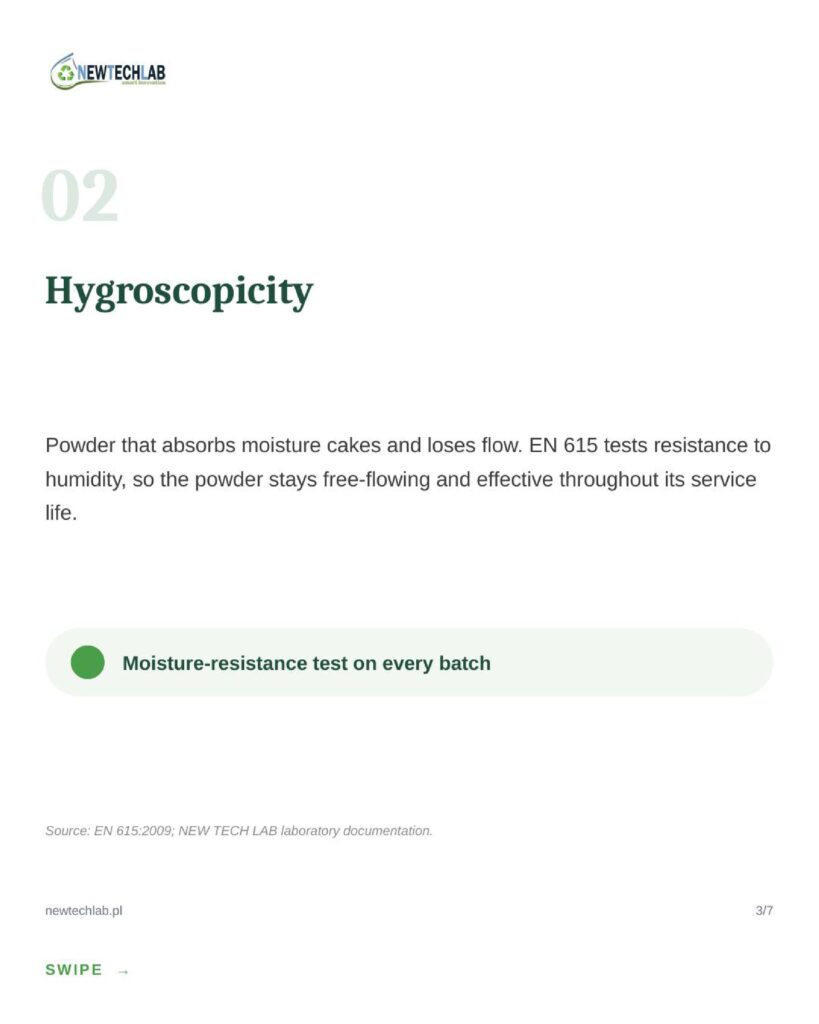
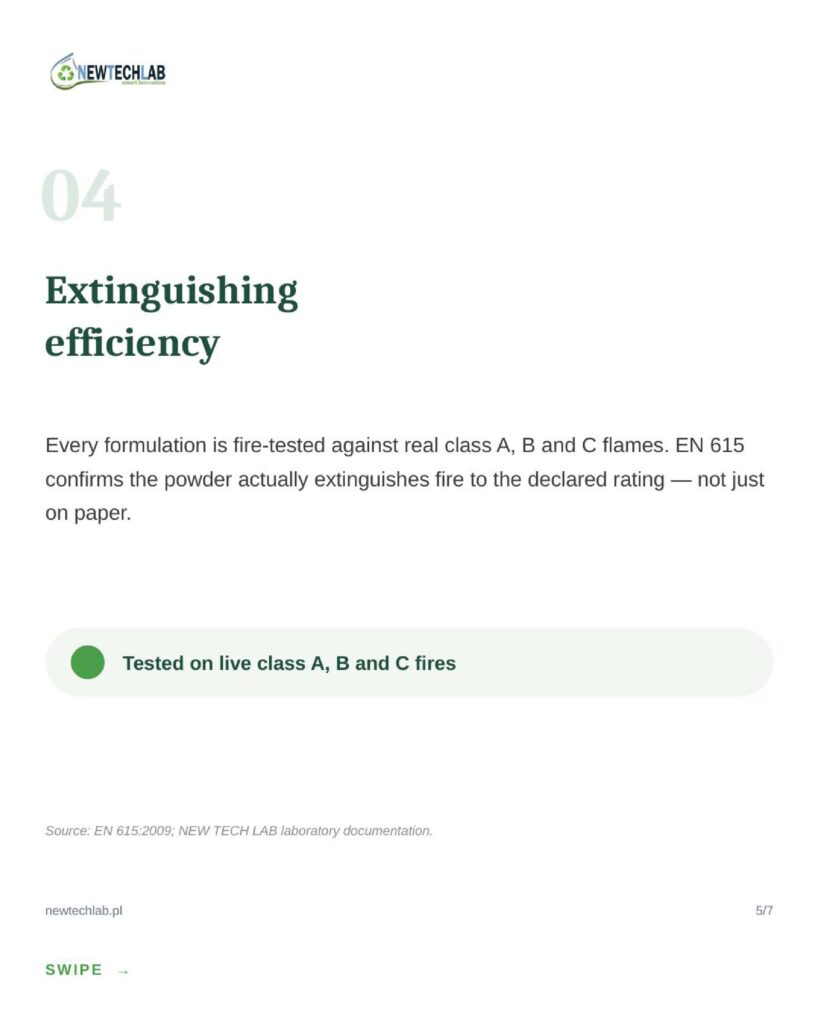
Parameters typically assessed include: the powder’s particle size distribution, resistance to moisture absorption, density, flowability (flow rate), and resistance to caking during storage. These are complemented by actual extinguishing efficiency tests, carried out on a 6 or 9 kg extinguisher according to the declared fire class.
The standard also specifies that its requirements apply exclusively to powders intended for classes A, B and C; it does not cover powders for metal fires, class D (en-standard.eu).
For companies purchasing ABC powder, this means EN 615 compliance should always be verified through the technical documentation supplied by the manufacturer, not through the product’s external characteristics.
Virgin vs certified regenerated powder
A “virgin” ABC extinguishing powder is manufactured from new raw materials. A certified regenerated powder, such as NTL GREEN, instead comes from the recovery of expired ABC extinguishing powders, subjected to a controlled regeneration process before being placed back on the market as a certified product.
The substantial difference does not concern the performance requirements: EN 615 does not distinguish between virgin or regenerated origin, but sets the same minimum chemical-physical and extinguishing parameters for any ABC powder intended for sale. This means a certified regenerated powder must pass the same tests as a virgin powder to be marketed.
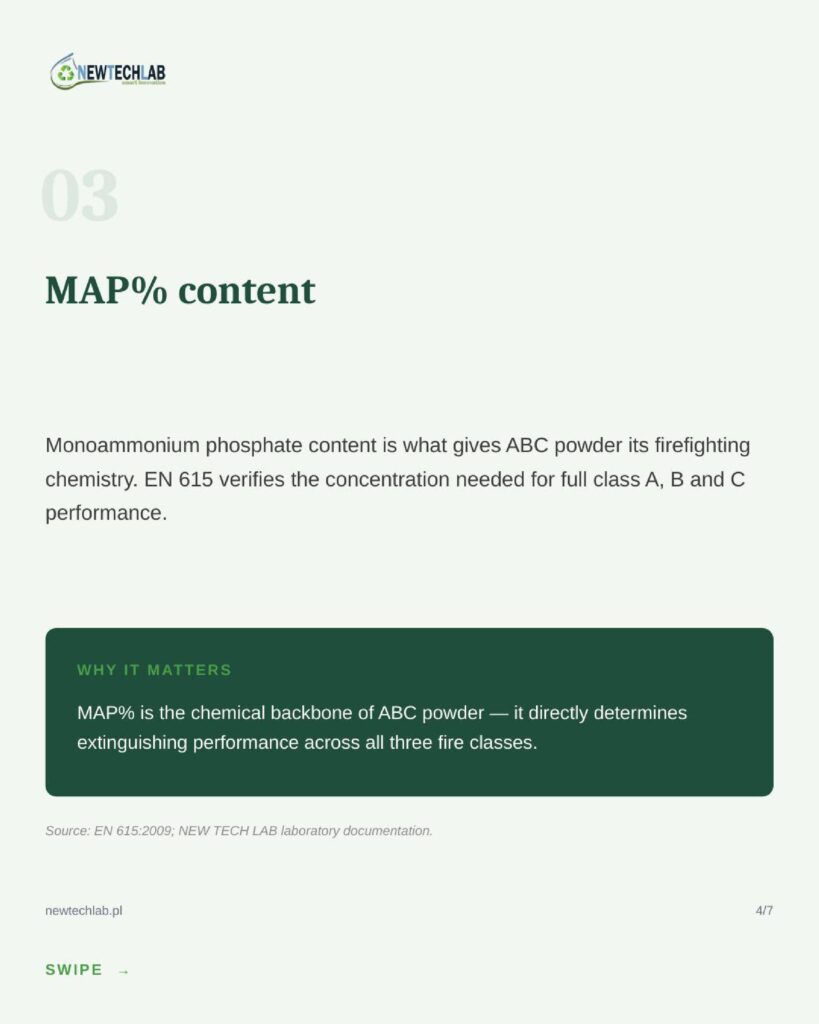
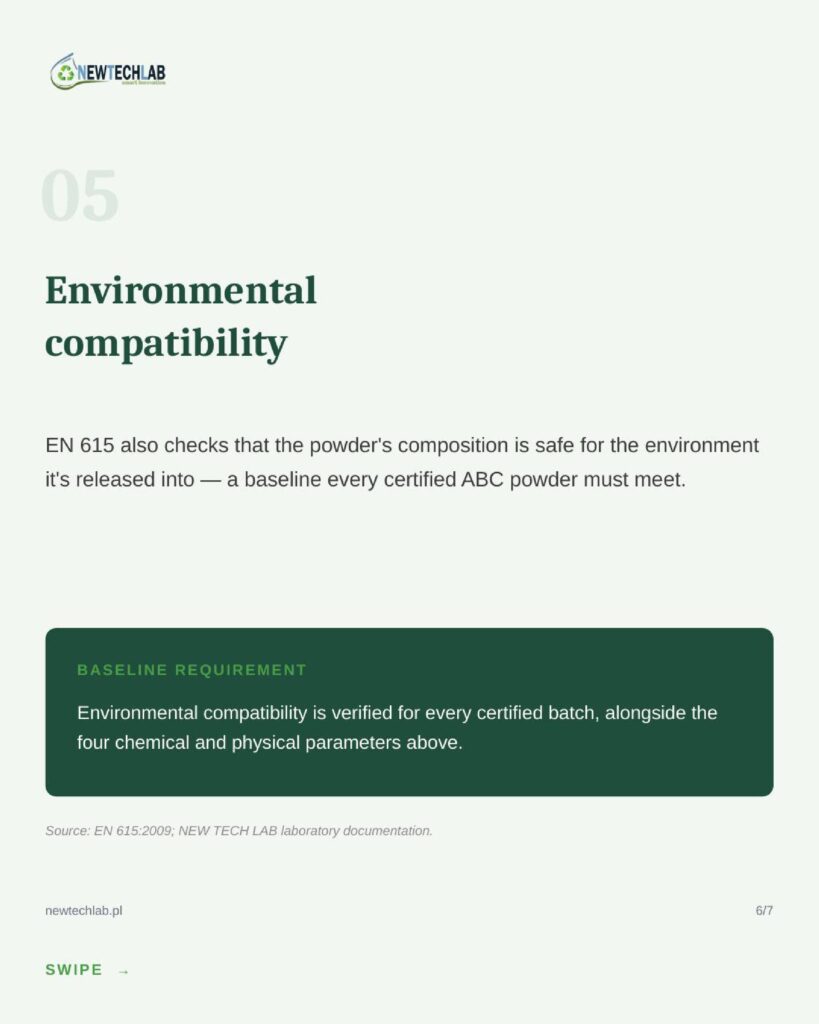
At NEW TECH LAB, every batch of NTL GREEN undergoes, before being placed on the market, a series of in-house laboratory analyses that include particle size distribution (granulometry), hygroscopicity, monoammonium phosphate content (MAP%), extinguishing efficiency and environmental compatibility. These checks, carried out within an ISO 9001-certified quality management system, ensure the regenerated product meets the same requirements EN 615 sets for virgin powder.
Traceability of the entire process — from the collection of expired ABC extinguishing powders through regeneration to the sale of the certified product — is guaranteed by BDO registration (no. 000141354) and KPO waste transfer documentation, which allow every stage of the supply chain to be reconstructed for each batch produced.
How NTL GREEN meets EN 615
NTL GREEN is NEW TECH LAB’s certified product obtained from the regeneration of expired ABC extinguishing powders, classified as non-hazardous special waste and managed through a traceable collection, transport and regeneration process.
Before being placed on the market, every batch of NTL GREEN undergoes five in-house laboratory tests: particle size distribution, hygroscopicity, MAP% content, extinguishing efficiency and environmental compatibility. These tests verify compliance with the chemical-physical and extinguishing parameters EN 615 requires for class A, B and C powders.
The entire analytical process is governed by an ISO 9001-certified quality management system, which ensures traceability and repeatability of controls on every batch produced. This is complemented by ISO 14001 (environmental management) and ISO 50001 (energy management) certifications, which cover the company’s overall operations.
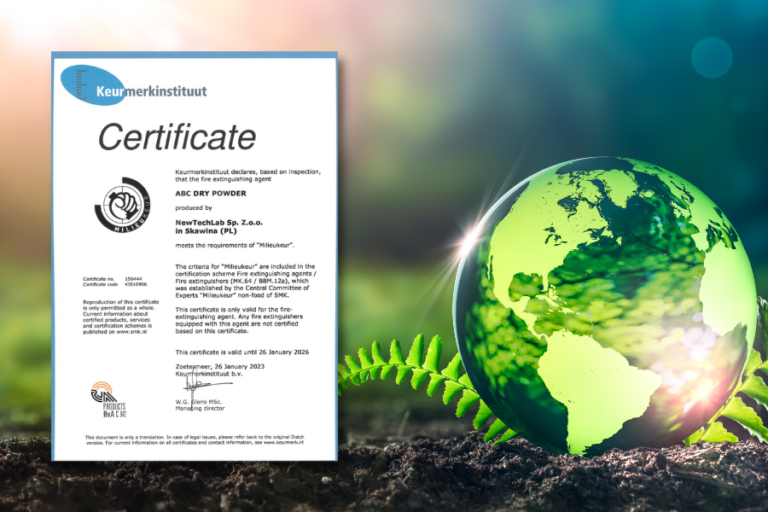
NTL GREEN has also obtained the Green Certificate from the Keurmerk Institute, issued in 2023 and reconfirmed in 2025, confirming the quality of the regeneration process.
For a client needing to dispose of expired extinguishers or ABC extinguishing powders, this means being able to rely on a certified regenerated product, verified against the same requirements EN 615 sets for virgin powder, with full documentary traceability through BDO and KPO.
FAQ
EN 615:2009 is the European standard that sets the minimum chemical-physical requirements and minimum extinguishing performance for class A, B and C extinguishing powders, excluding powders for class D fires.
Yes. EN 615 does not distinguish between virgin or regenerated origin: both must pass the same chemical-physical and extinguishing tests to be considered compliant and marketable.
Yes. Every batch of NTL GREEN is tested in-house for particle size distribution, hygroscopicity, MAP%, extinguishing efficiency and environmental compatibility, in line with the parameters EN 615 requires.
The standard requires manufacturers to provide customers with specific data and information for each supply, describing the product’s chemical-physical characteristics.