
ESG reporting in fire safety: CSRD data after the omnibus
Key takeaways
- CSRD still exists, but it now applies mainly to EU companies with more than 1,000 employees and €450 million in net turnover.
- The simplified ESRS apply to financial years starting on or after 1 January 2027, with early use allowed for 2026.
- Large buyers cannot demand more than voluntary-standard data from partners with fewer than 1,000 employees.
- Fire safety suppliers can still support buyers with traceable waste records and management-system evidence.
- As of October 2026, NEW TECH LAB holds no verified GHG certification, certified LCA study or published ESG/CSRD report.
What changed in CSRD in 2026
The Corporate Sustainability Reporting Directive (CSRD) was not repealed, but its reach is now much smaller. Directive (EU) 2026/470 was adopted on 24 February 2026 and published in the Official Journal on 26 February 2026 (EUR-Lex).
The European Commission confirms that it entered into force on 18 March 2026 (European Commission). After the omnibus, CSRD applies to EU companies with more than 1,000 employees and more than €450 million in net turnover (PwC Viewpoint).
Member States must transpose the reporting changes into national law by March 2027 (Deloitte DART). For a fire safety supplier, this means many small and mid-sized firms are no longer directly obliged to publish a CSRD report. Their customers, however, may still be in scope.
Simplified ESRS: the dates that matter
The European Sustainability Reporting Standards (ESRS) were also revised. Here is the timeline confirmed by official and professional sources:
- 3 July 2026: the Commission adopted the delegated acts on the revised ESRS and on a voluntary reporting standard (EFRAG).
- 21 September 2026: both acts were published in the Official Journal as Regulations (EU) 2026/1563 and 2026/1560 (DRSC).
- 10 November 2026: the revised ESRS regulation enters into force, with no national transposition needed (PwC Viewpoint).
- Financial years starting on or after 1 January 2027: mandatory application, with early application allowed for 2026 (EFRAG).
According to the Commission, as reported by Herbert Smith Freehills Kramer, the revised ESRS cut mandatory datapoints by more than 60% and total datapoints by more than 70%, while keeping key concepts such as double materiality.
Why buyers still ask suppliers for data
Companies in scope report on their own value chain, so they still need information from partners. The omnibus sets a limit, though: in-scope companies may not seek information from value-chain undertakings with fewer than 1,000 employees, except what the voluntary sustainability standards specify (Norton Rose Fulbright).
In practice, the voluntary standard becomes the reference scope for small suppliers. The sensible approach is to keep consistent records once and reuse them for every customer request, instead of building a new answer each time.
Environmental KPIs buyers commonly request
The GHG Protocol splits a company’s emissions into three scopes.
- covers direct emissions from owned or controlled sources.
- covers indirect emissions from purchased energy.
- covers all other indirect emissions in the value chain (GHG Protocol). A customer’s scope 3 can include what it buys from suppliers, which is why data requests reach fire safety companies.
The list below is NEW TECH LAB’s editorial view of useful supplier KPIs. It is not a list prescribed by ESRS:
- Tonnes of end-of-life extinguishers and extinguishing powders collected and processed.
- Share of each material stream sent to recovery or regeneration.
- Energy consumption per tonne of treated waste.
- Number of waste transfer cards issued per period.
- Valid management-system certificates and their scope.
Any CO₂ or energy figure derived from these KPIs must be labelled “NEW TECH LAB internal estimate” or “illustrative comparison — not a certified claim” until independently verified.
Traceable waste records as ESG evidence
Documented waste handling is the most concrete evidence a collection and recycling company can offer. According to its website, NEW TECH LAB holds an individual BDO registration number and submits waste cards through the online system (NEW TECH LAB, About us).
The company also operates under a decision issued by the Starosta of Kraków District and the Chief Inspector for Environmental Protection, covering transport, recycling and processing of fire extinguishing waste (NEW TECH LAB, About us).
End-of-life ABC powder extinguishers fall under EWC code 16 05 05, a non-hazardous special waste, and each transfer is documented with a KPO (Karta Przekazania Odpadów, the waste transfer card). These records let a buyer trace material from collection to final recovery.
Management systems behind the data
Records are more credible when they sit inside a certified management system. NEW TECH LAB states that its analytical laboratory and operations follow ISO 9001, ISO 14001 and ISO 50001 (NEW TECH LAB, home page).
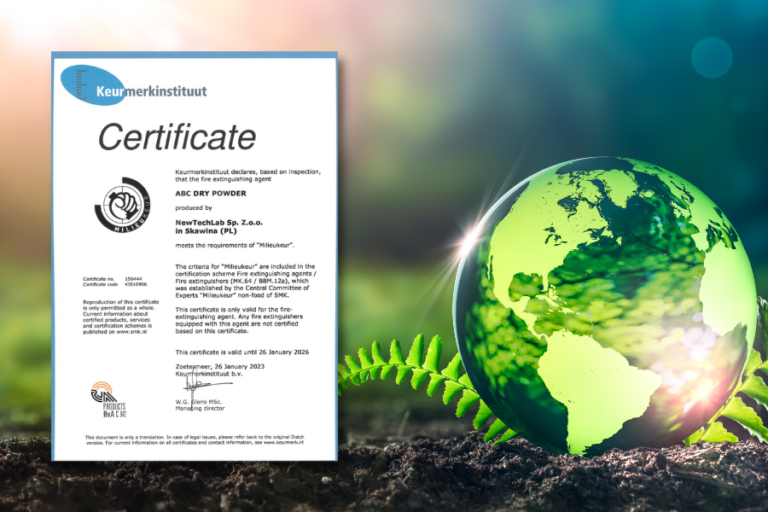
Its regenerated ABC powder, NTL GREEN, is a certified product that complies with PN-EN 615:2009 and is certified by Keurmerk Institute (NEW TECH LAB, home page). These certificates describe quality, environmental and energy management. They are not a substitute for a verified greenhouse gas inventory.
What NEW TECH LAB can and cannot claim
Transparency matters more than ambition here. As of October 2026, NEW TECH LAB does not yet hold a verified GHG certification, a certified life cycle assessment (LCA) study or a published ESG/CSRD report. The company follows the evolution of the framework and keeps the underlying records ready. Until independent verification exists, any environmental figure shared with customers should be presented as an internal estimate.
FAQ – Frequently asked questions
Yes, but more narrowly. Directive (EU) 2026/470 limits it mainly to EU companies with over 1,000 employees and €450 million net turnover. Member States must transpose the reporting changes by March 2027.
They apply to financial years starting on or after 1 January 2027, with early application allowed for 2026. The regulation enters into force on 10 November 2026.
Only within limits. In-scope companies may not seek more from partners under 1,000 employees than the voluntary standards specify. Suppliers can still choose to share more.
No. As of October 2026 it has no verified GHG certification, certified LCA study or published ESG/CSRD report. It does follow ISO 9001, ISO 14001 and ISO 50001 and keeps BDO-based waste records.
Under the GHG Protocol, scope 1 is direct emissions from owned or controlled sources. Scope 2 is indirect emissions from purchased energy. Scope 3 is all other indirect emissions in the value chain.
Sources
- Directive (EU) 2026/470, EUR-Lex
- Corporate sustainability due diligence, European Commission
- Omnibus directive finalised, PwC Viewpoint
- Omnibus directive published, Deloitte DART
- Omnibus adoption and value-chain cap, Norton Rose Fulbright
- Delegated act on revised ESRS and voluntary standard, EFRAG
- Final delegated acts published in the Official Journal, DRSC
- ESRS (2026) deep dive, PwC Viewpoint
- Revised ESRS become final, Herbert Smith Freehills Kramer
- GHG Protocol scopes diagram, GHG Protocol